Keep git push.
Own the server.

Deploy to any Linux server from Git, the CLI or your AI agents.

Get started

SHEET 1

Survey map sheet of a valley with contour lines, the lake Loch Ard, woodland and a blue numbered grid. The deploy route is drawn over it.
hel1-web-01apiwebworker
1git push
2build on server
3health check
4swap traffic
5live
  1. git push
  2. build on server
  3. health check
  4. swap traffic
  5. live
  6. The route ends at server hel1-web-01, which runs api, web and worker.

Platform

Deploy

1git push
2build on server
3health check
4swap traffic
5live

Deploy route: git push, build on server, health check, swap traffic, live.

Fig. 1. Sheet 2. A push becomes a release in five steps.
  • Push to deploy from GitHub or Gitea. The image is built on your server, not ours.
  • A health check gates every release. Traffic swaps blue-green, and a failed check rolls back on its own.
  • The CI gate holds a deploy until your checks are green. Newer pushes supersede a waiting deploy.
  • Deploy status is posted back to GitHub and Gitea as commit statuses.
  • Stacks deploy a multi-service compose repo as one unit.
  • External Deployments keep proxy routes in sync when your own CI runs docker compose.
$ reoclo apps ls
SLUG            SERVER       CI   LAST DEPLOY   REF
api             prod-web-1   on   ✓ succeeded   deadbeef
worker          prod-web-1   on   ✓ succeeded   deadbeef
docs            staging-web  off  ✓ succeeded   abc1234
admin           prod-web-1   off  ✗ failed      cafe999
Output as shown in the CLI reference.

Operate

$ reoclo servers metrics reoclo-production
cpu:   12% (1m), 18% (5m), 22% (15m)
mem:   3.2 GB / 8.0 GB (40%)
disk:  /        24 GB / 80 GB (30%)
       /var/lib 8.2 GB / 40 GB (20%)
Fig. 2. Sheet 3. Runner readings, as shown in the CLI reference.
  • Logs from every server, kept 30 days. Search them, or tail them live.
  • A browser terminal and reoclo shell, both over the runner. No inbound SSH.
  • Restart, recreate and scale containers. Manage volumes.
  • Uptime monitors, and status pages on your own hostname.
  • Alerts with routing and mutes. Auto-heal restarts a down app container.
  • A managed proxy with automatic TLS, wildcard and redirect domains, IP allowlists and Cloudflare DNS.

Agents

mcp.reoclo.com
Claude Code
Cursor
Zed

Claude Code, Cursor and Zed each reach your server through the Reoclo MCP server.

Fig. 3. Sheet 4. Any MCP client reaches the same tools.
  • A hosted MCP server with OAuth, or stdio through reoclo mcp.
  • 108 tools. Works with Claude Code, Cursor, Windsurf, VS Code, Zed, JetBrains and Cline.
  • Scoped, revocable automation keys and machine users.
  • Deploys and server actions are audit-logged with the actor and the outcome, and so are secret reveals and pipeline resolves.
  • Not every dashboard action has a tool. Secret values never travel over MCP.
$ claude mcp add reoclo -- npx -y @reoclo/cli mcp
  • list_servers
  • get_server_health
  • trigger_deploy
  • get_deployment_stages
  • search_logs
  • restart_container
Setup command from the MCP guide. Tool names as defined by the server.

Gazetteer

FeatureEntry
Secrets ManagerVersioned values, per-project grants, 1Password and Bitwarden sync, and reoclo run for CI.
StacksMulti-service compose repos deployed as one unit, with task members and prune.
Status pagesComponents and incidents on your own hostname, with managed TLS.
LogsContainer and journal logs from every server. 30-day retention, search and live tail.
MonitorsUptime checks that notify the channels you choose.
Domains and proxyAutomatic TLS, wildcard and redirect domains, IP allowlists, Cloudflare DNS.
RunnersDocker, Podman and Lite. Kubernetes workloads are visible, read only.
CLI22 commands, an rc alias, and JSON or YAML output for scripts.
GitHub and Gitea ActionsFive actions: run, checkout, docker-auth, load-secrets and deploy-sync.
NotificationsEight channels: email, Slack, Discord, Teams, PagerDuty, OpsGenie, Matrix and signed webhooks.
Passkeys and 2FAEmail codes, passkeys, authenticator apps and security keys. No passwords.
Roles and auditOrg roles, custom roles, groups, and an audit log with actor and outcome.

Secrets stay secret. Every reveal and pipeline resolve is logged.

Secret values are sealed at rest and opened on three paths: a deploy whose environment references them, an automation key or machine user token in CI, or a person with a grant who reveals or gets a value. Every reveal is written to the audit log before the value is shown.

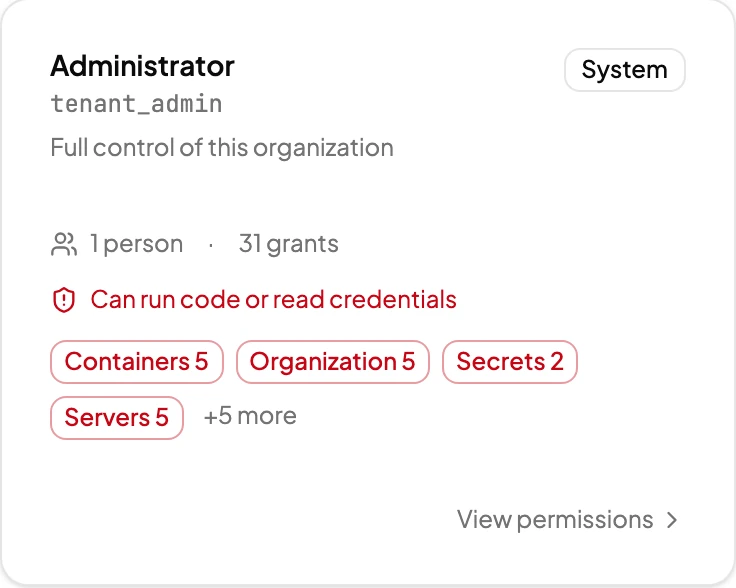
Reoclo dashboard role card for Administrator: full control of the organization, 31 grants, with permission groups for containers, organization, secrets and servers.
Fig. 4. The built-in Administrator role. Dashboard screenshot, sample organization.
Encrypted at rest
Secret values are sealed with AES-256-GCM, each secret with its own key. Decryption sits behind a single internal boundary.
Opened on three paths
A deploy whose environment references the secret; an automation key or machine user token in CI, where reoclo run injects values into a child process and never writes them to disk, and the load-secrets Action exports them to the workflow environment; or a person with a grant who reveals or gets a value.
Fails closed
Read paths fail closed, and secret values never travel over MCP.
No passwords to leak
Sign in with an email code or a passkey. Authenticator apps and security keys add a second factor.
Scoped keys
Automation keys and machine users carry only the operations you grant, and revoke instantly.
An audit trail
A reveal is written to the audit log before the value is returned. Each pipeline resolve is logged by key name, never by value. Deploys and server actions are logged with the actor and the outcome.

Open beta. Free to start.

Sign-up is open. Every account starts on the Starter plan and can create up to three free organizations. Plans are tiered, and paid tiers are published here as they open.

  • Push to deploy from GitHub or Gitea
  • Runners on Docker, Podman or Lite
  • Logs with 30-day retention, search and live tail
  • Uptime monitors and status pages
  • Secrets Manager with versioned values
  • Hosted MCP server and the reoclo CLI
  • Roles, passkeys and an audit log
  • Self-serve onboarding, with support when you need it

Questions, answered on the sheet

Is sign-up open?

Yes. Sign-up is open during the beta. Create an account with an email code or a passkey, name your organization, and connect your first server. Every account can create up to three free organizations.

How is Reoclo different from Render, Railway, or Vercel?

They run your code on their infrastructure at a markup. Reoclo runs the same push-to-deploy workflow on servers you own, so the hosting bill is yours to set. Your agents get a hosted MCP server, and everything is scriptable from the CLI.

How is it different from Coolify, CapRover, or Kamal?

Those are tools you install, update, and babysit yourself. Reoclo is a managed control plane: you bring the servers, we run the platform. Agents, status pages, a Secrets Manager, and an audit log come in the box.

What does MCP-native actually mean?

Reoclo ships a hosted MCP server with OAuth, and a stdio server through the reoclo mcp command. 108 tools cover deployments, logs, servers, containers, domains, monitors, status pages, stacks, and scheduled operations. It does not cover every dashboard action: secret values, roles, and billing stay in the dashboard and the CLI. Each call runs under a scoped identity.

Can an agent break production?

Only what you scope it to. Automation keys and machine users follow the same RBAC as people. Grant read-only, restrict to one app or environment, or revoke on the spot.

Which servers and clouds do you support?

Any Linux server with an IP address. Reoclo installs a small runner (Docker, Podman, or a Lite runner without Docker) that connects outbound, so no inbound ports are needed. Optional integrations for AWS, Hetzner, and RunPod add power controls and provider metrics where the provider supports them. The runner image is source-available on Docker Hub.

Is my data secure?

Secret values are encrypted at rest with AES-256-GCM, each secret sealed with its own key. They are decrypted only on three paths: a deploy whose environment references them, an automation key or machine user token in CI, or a person with a grant who reveals the value in the dashboard or with reoclo secrets get. In CI, reoclo run injects values into a child process and never writes them to disk, and the load-secrets Action exports them to the workflow environment. A reveal is written to the audit log before the value is returned, and secret values never travel over MCP. Sign-in is passwordless, with email codes and passkeys, and optional authenticator or security-key 2FA. Deploys and server actions are audit-logged with the actor and the outcome, and so are secret reveals and pipeline resolves.

What happens when a server goes down?

The runner keeps a persistent connection. When a server stops answering, it is marked unreachable and your alert channels fire. If an app container goes down, auto-heal restarts it. The server recovers automatically when connectivity returns.

Do I have to set up logging myself?

No. Reoclo collects container and journal logs from every server and keeps them for 30 days. Search, tail, and filter from the dashboard or the CLI, or hand the question to your agent.
Put your first server on the map.

Sign-up is open during the beta. Create an account with your email, name your organization, and connect your first server.